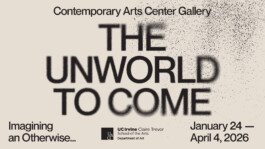
The Unworld to Come. Imagining an Otherwise…
With Marwa Arsanios, Ashley Hunt, Natascha Sadr Haghighian, virgil b/g taylor
Curated by Juli Carson, Annika Haas, and Sasha Ussef
Jan 24, 2026 to Apr 04, 2026
Contemporary Arts Center, University of California Irvine
Feb 7, 2–5pm reception
March 7, 12-6pm research workshop
“If this world is as shitty as we think it is, then why repair it!” demands Jack Halberstam, pointing to the layers of brokenness that render life across this planet increasingly precarious—or nearly impossible. In response, The Unworld to Come takes up climate change as a poly-crisis with ideological dimensions, featuring artists who attempt to “imagine an otherwise” within the entangled struggles for climate, economic and social justice, and beyond.
As a guiding principle, the curators have drawn upon Bernard Stiegler’s notion of the neganthropocene—a deconstructed take on what scholars call the Anthropocene: that epoch defined by humans’ effect on the Earth’s ecosystem. From this approach the question is not only how we arrived here, but how a life worth living might be imagined within it. Central to this query is the recognition that the climate crisis spans a broad terrain: from ecocide masked as “green transition,” to the disregard for the dignity of migrants displaced by rising seas and neo-colonial regimes.
And yet, the Californian idea of a ‘whole earth’ remains a powerful tactic for short circuiting racialized neoliberal capitalism and its extractionist disregard of natural resources and human well-being. With Halberstam, if the curators choose to engage the “gritty, dirty, messy, disorderly unworld to come,”3 it is therefore not a post-apocalyptic stance. Rather, it is an attempt to perceive the climatic collapse and brokenness as the real (not imagined) condition of our interconnected present, and to further ask how we might live—critically and generatively—within it.
All of this is to say that the question of climate isn’t just one of weather patterns, but a broader one of geopolitical trends that, in turn, produce patterns of forced migration and ultimately detention and deportation. Enter Ashley Hunt, virgil b/g taylor, Marwa Arsanios, and Natascha Sadr Haghighian whose artwork in The Unworld to Come stages an in-situ dialogue that makes unexpected connections between the movements of people and the biosphere. In so doing, a means of living otherwise within the Anthropocene is imagined. It’s an important choice, because as Halberstam puts it, “If you fall and break you cannot be put back together in the [exact] way you were.”
This exhibition inaugurates the first phase of The Neganthropocene: Empire/Money, Science/Politics, Art/Intervention, a three-part research project by Juli Carson and collaborators under the umbrella of University of California Climate Actions Arts Network (UC CAAN)—a system-wide initiative uniting researchers, scholars, students, and community partners to confront the climate crisis through the transformative power of the arts. UC CAAN is made possible with generous support from the University of California, Office of the President’s Multicampus Research Programs and Initiatives (MRPI) grant program.
Jack Halberstam, “Unworlding,” Journal of Architectural Education 78, no. 2 (2024): 272, https://doi.org/10.1080/10464883.2024.2382056.
Bernard Stiegler, The Neganthropocene, trans. Daniel Ross (London: Open Humanities Press, 2018).
Collapse as a Condition of (Un)Knowing
Facilitated and organised by Annika Haas.
With contributions by Jonathan Alexander, Juli Carson, Ashley Hunt, and Mark Minch-de Leon.
Research Workshop, March 7, 2026, 12–6pm
Contemporary Arts Center, University of California Irvine
To join the workshop, please register here.
Collapsing climates—cultural, political, and meteorological—have become a shared, yet unevenly experienced condition of the contemporary poly-crisis. Deconstructive approaches to humans’ effect on the Earth’s ecosystem such as Bernard Stiegler’s Neganthropocene, underscore the close links between collapsing climates and the ideological paradigms that powerfully impact our capacities to survive—or live critically within it. Yet the experience of collapse, as both material and affective conditions of life on this planet, remains a question of positionality. Related injustices are mounting among different geopolitical and climatic regions, within their stratified societies and irreparably damaged ecologies.
The workshop focuses on cultures of knowing which are equally affected by collapsing climates. This concerns the struggle for evidence and testimony, the reality of epistemicides alongside the expansion of computational, neocolonial information infrastructures, as well as the difficulties to engage with various embodied, ancestral and relational ways of knowing (through) damage and pain as well as destruction, disaster and death in the context of the Westernized university.
The workshop also confronts persistent ideas that dominate the anticipated horizon of collapse and its imaginary counterparts—such as repair, wholeness, restoration and reproduction, archival preservation, technological solutionism, securitization and straightness—with the experience of unknowing, discomfort and failure that surround what Jack Halberstam terms as the "gritty, dirty, messy, disorderly” unworld to come. This unworld becomes tangible not despite, but through collapse and its diverse temporal, epistemic as well as affective layers encompassing disappointment, delusion, dissociation as well as despair. Engaging with these layers and their aftermaths, the workshop explores possibilities and forms of imagining an otherwise that may point towards ways of “living and thinking and feeling otherwise, through the brokenness."
Organized in parallel with the exhibition The Unworld To Come. Imagining an Otherwise…, on view at the Contemporary Arts Center (CAC) Gallery through April 4, 2026, this workshop engages artwork by Marwa Arsanios, Virgil B/G Taylor, Ashley Hunt, and Natascha Sadr Haghighian as a point of departure for collective inquiry. Structured through joint writing exercises, shared research, and conversation, the workshop convenes participants to think through collapse as a lived, uneven, and contested reality that shapes how knowledge is produced, felt, and withheld.